

Air Duct Inspection, Repair & Sealing San Jose, CA: Methods, Materials & Best Practices
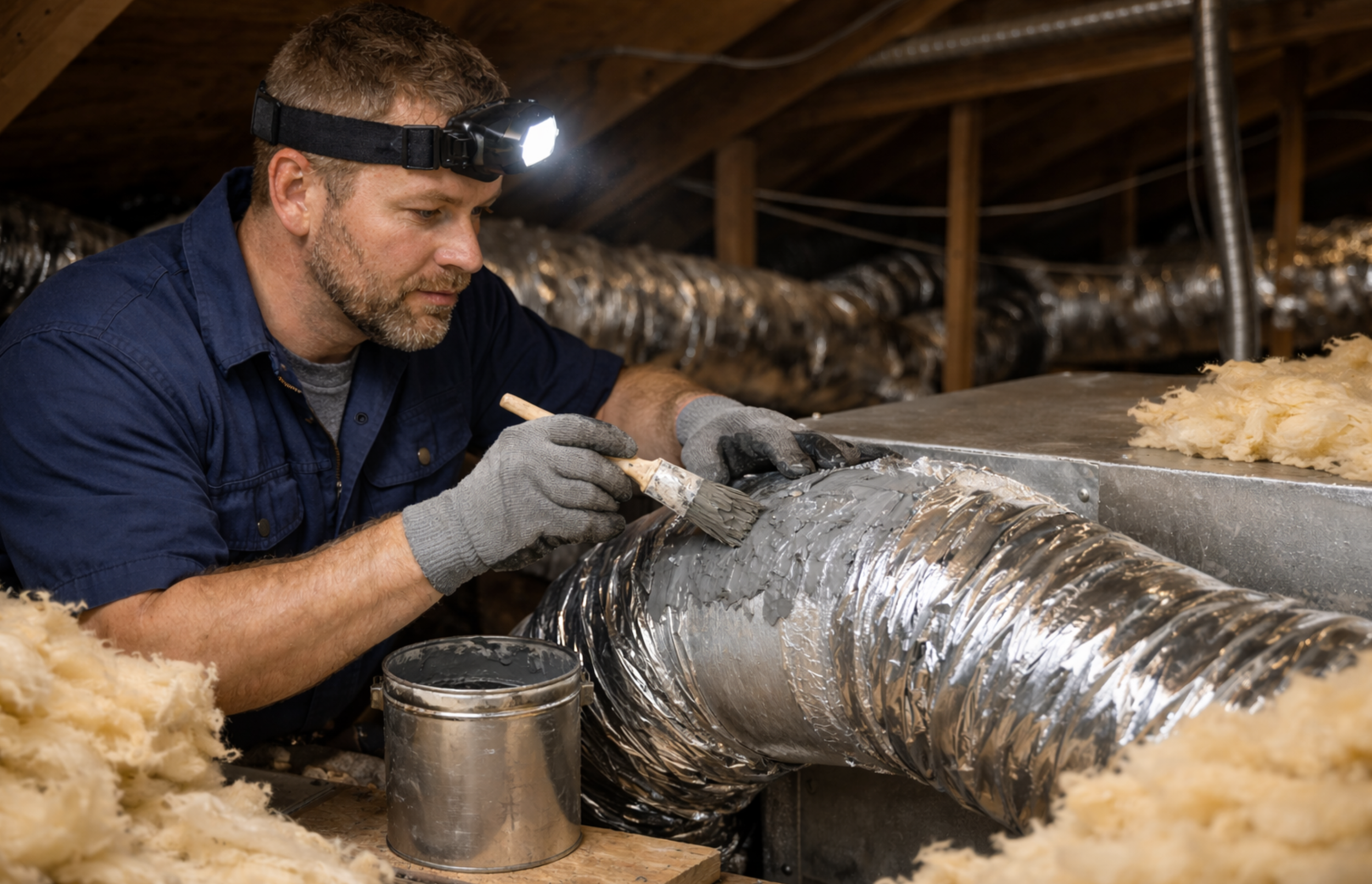
HVAC technician in a San Jose attic applying mastic sealant to a flexible duct connection on a 1960s ranch-style home.
Quick Answer
If your San Jose home was built between the 1950s and 1980s — and most were — your duct system has almost certainly developed leaks at joints, seams, and connections over the decades. The U.S. Department of Energy estimates that the average home loses 20–30% of conditioned air through duct leaks. That means your system is working significantly harder than it needs to, driving up your PG&E bill while leaving some rooms chronically uncomfortable. The fix is a proper inspection using pressure testing and visual checks, followed by repair of any damaged sections and sealing with mastic compound or specialty HVAC sealing tape (such as Foil Grip) — not the generic “duct tape” or standard foil tape from the hardware store.
Need Air Duct Inspection, Repair, and Sealing in San Jose? We find the leaks, show you what we found, and seal it right the first time.
Serving San Jose—including Willow Glen, Cambrian Park, Almaden Valley, Evergreen, Berryessa, and surrounding South Bay communities.
Duct Problems in Real San Jose Homes
San Jose’s housing stock is almost entirely mid-century. Much of the city was built between the 1950s and 1970s — think ranch-style tracts in Cambrian Park, post-war bungalows in Willow Glen, and the flat-lot neighborhoods of East San Jose that filled in rapidly during the tech boom. Many of these homes had ductwork installed when forced-air systems were a relatively new residential technology, and the standards for sealing joints were far more relaxed than what California’s Title 24 now requires.
In most of these homes, the duct system runs through the attic. That’s a problem for two reasons. First, San Jose attics can get extremely hot in summer — well above 130°F during offshore heat events when temperatures spike past 100°F in the valley. Those temperature extremes cause flex duct to expand, contract, and eventually pull apart at connections. Second, when supply ducts leak in an unconditioned attic, you’re pumping expensively cooled air into a space that’s already super-heated. Your system runs longer, your bills climb, and your living spaces never quite reach the thermostat setpoint.
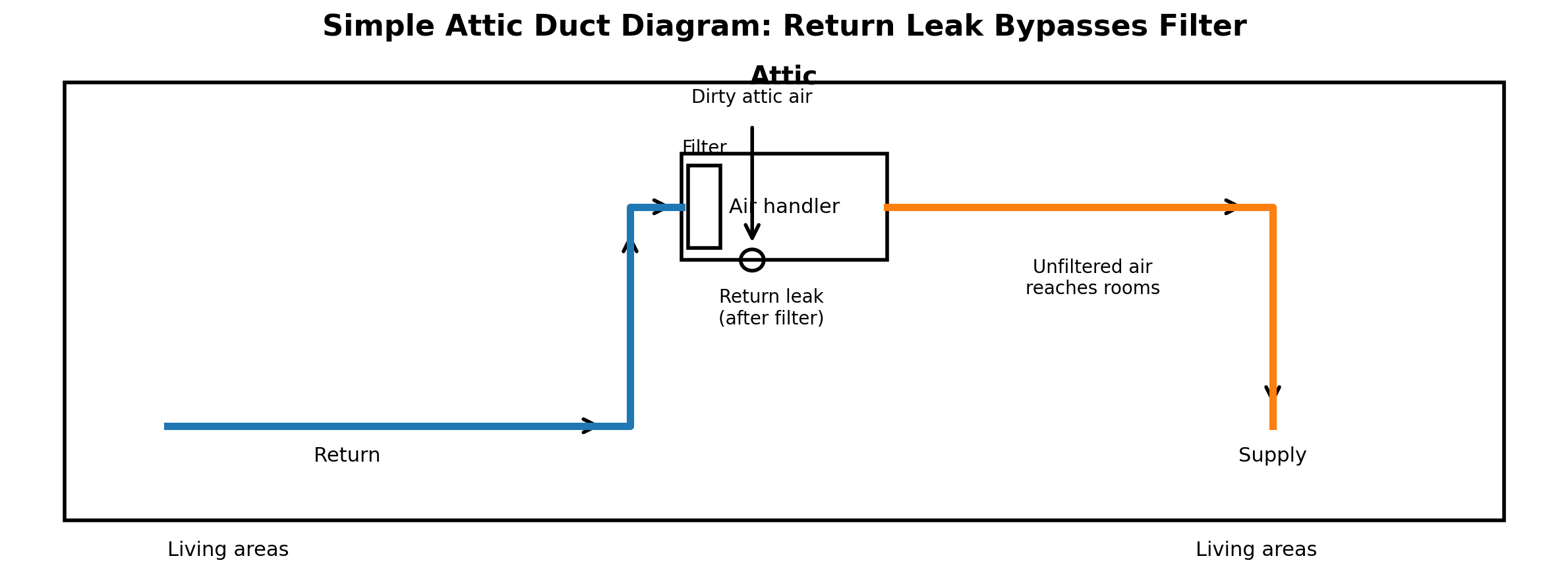
In older Cambrian Park ranchers, the return duct system is often the bigger issue. Returns that weren’t properly sealed at the cabinet pull in attic air — along with dust, insulation particles, and in wildfire season, smoke — and distribute it directly to living areas. Residents of Almaden Valley and Evergreen, where newer construction used higher-quality flex duct, often still have sealing failures at the register boots and plenum connections that go undetected for years.
Why “Blow-and-Go” Doesn’t Work
The fastest version of duct sealing is to apply a strip of standard cloth-backed duct tape across a visible gap and call it done. HVAC technicians call this “blow-and-go” — get in, patch the obvious stuff, and leave. The problem: duct tape fails. It’s not rated for the temperature swings inside a San Jose attic, and the adhesive degrades within a year or two. The joint opens back up, and you’re right back where you started.
A proper inspection doesn’t start at the ducts — it starts at the air handler. The technician should perform a duct leakage pressure test (often called a “duct blaster” test) to actually quantify how much air your system is losing and pinpoint which zones are leaking most. Visual inspection alone misses leaks behind drywall, in wall cavities, and at register boots that are buried under blown insulation.
Sealing that lasts uses one of two materials: mastic sealant (a thick, brush-applied paste that cures to a durable, flexible seal) or specialty HVAC sealing tape (such as Foil Grip) for areas where mastic can’t be applied effectively. These are purpose-made tapes rated for the temperature cycling and pressure demands inside an HVAC duct system — not generic foil tape from a hardware store, which lacks the proper adhesive formulation for long-term duct applications. For gaps larger than ¼ inch, fiberglass mesh tape should be embedded in the mastic first to bridge the gap. Once sealed, ducts in unconditioned spaces — like your attic — should also be insulated to prevent heat gain and condensation problems.
When a Different Approach Is Safer
A handful of situations require more care before you start sealing and pressing ducts.
Older homes with asbestos-wrapped ductwork. Some San Jose homes built in the 1950s and early 1960s used asbestos-containing insulation on HVAC components. If your system dates to that era and you see gray or white wrap that looks like it’s beginning to degrade, stop. Have a licensed abatement professional assess before any sealing work starts.
Disconnected return ducts near gas appliances. If your gas furnace has a disconnected return air path or negative pressure is pulling combustion gases backward, sealing supply leaks first can make backdrafting worse. A combustion safety check should precede any duct sealing in homes with natural gas furnaces, water heaters, or dryers.
Known mold or moisture intrusion. Sealing ducts over a moisture problem traps the condition and makes it harder to remediate later. If there’s evidence of water intrusion or mold in the duct system, that needs to be addressed before sealing.
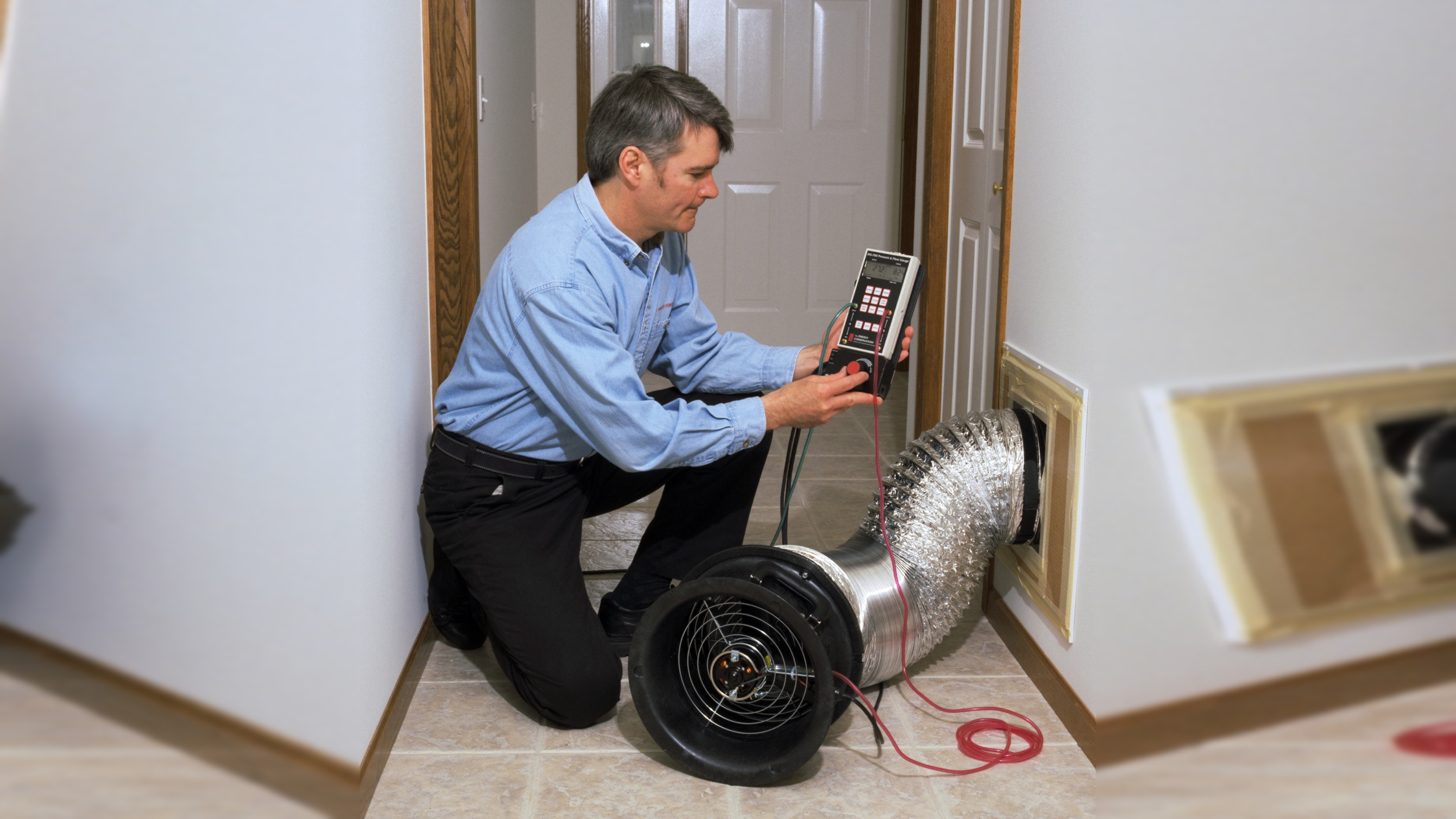
HVAC technician conducting a duct pressure test using a duct blaster fan mounted in an access panel — shows the diagnostic approach, not just cosmetic tape work
When Air Duct Inspection, Repair, and Sealing Actually Makes Sense
Your energy bills have climbed without a clear change in usage habits
Some rooms are chronically hot or cold regardless of thermostat setting
You bought a home built before 1990 and have never had the duct system inspected
Your HVAC system is short-cycling or running excessively long to reach set temperature
You’ve noticed dusty return vents or dirty filters that keep loading up fast
Wildfire smoke smell lingers inside days after Bay Area air quality improves
You’re upgrading to a heat pump and want the duct system to match the new system’s efficiency
Visible flex duct sags in the attic, which kinks airflow and creates pressure points
You’re in Willow Glen or Cambrian Park and planning to sell — a sealed duct system is an easy value-add on a pre-listing inspection
There are hot spots in East San Jose or Berryessa rooms farthest from the air handler
Your home is near wildland interface areas in Almaden Valley or the Diablo foothills — leaky returns are a direct smoke infiltration path
You just had a new HVAC system installed — new equipment connected to old leaky ducts will never perform to rated efficiency
Air Quality, Filtration, and San Jose’s Reality
San Jose sits at the southern end of the San Francisco Bay, which makes it unusually vulnerable to two distinct air quality problems. In summer and fall, offshore flow events push temperatures past 100°F and create ideal wildfire conditions. In recent years, smoke from fires as far away as Sonoma County has pushed San Jose’s AQI into “unhealthy” territory — During heavy wildfire seasons, the Bay Area can experience dozens of Spare the Air days, and leaky returns can pull smoke and odor into the system even after outdoor air improves. In winter, marine inversions trap surface-level pollution and particulate matter close to the ground, creating stagnant air episodes that the Bay Area Air Quality Management District (BAAQMD) monitors closely.
Leaky ductwork makes both problems worse. During a smoke event, a return duct that pulls air from a leaky attic is bringing smoke particles, ash, and combustion byproducts directly into your living areas — bypassing whatever filter you have. California’s Air Resources Board recommends MERV 13-16 filters or higher for wildfire events, but even a MERV 16 filter can’t help you if smoky attic air is entering upstream of the filter through return leaks.
Sealed ducts are the foundation of effective indoor air quality. Filtration upgrades help, but they only work on air that actually passes through the filter.
What a Proper Air Duct Inspection, Repair, and Sealing Process Looks Like
Initial walkthrough and system assessment. The technician reviews system age, configuration, and access points. In most San Jose homes, this means pulling an attic hatch and inspecting the main trunk, flex duct runs, and register boot connections. They’re looking for obvious disconnections, visible gaps, damaged insulation, and signs of moisture or pests.
Duct leakage pressure test (duct blaster). A calibrated fan is temporarily sealed into the air handler or a return grille. The system is pressurized and airflow is measured at known reference pressure. This tells the technician exactly how leaky the system is — total leakage to outside — before any work begins. It also generates a baseline for post-sealing verification.
Smoke pencil or zone-by-zone leak identification. With the system under pressure, the technician uses a smoke pencil or thermal imaging to trace leaks at connections, seams, and register boots. This identifies where the air is actually escaping, not just where it looks bad.
Surface preparation. All surfaces to be sealed are cleaned of dust and debris. Mastic bonds poorly to dirty surfaces — skipping this step is why many duct sealing jobs fail early.
Mastic application at joints and seams. Brush-applied mastic is worked into every seam, connection, and boot. On gaps larger than ¼ inch, fiberglass mesh tape is embedded in the mastic first. The goal is a continuous, airtight seal at every transition point.
Specialty HVAC sealing tape (such as Foil Grip) for accessible sheet metal sections. Where flex duct connects to sheet metal collars or plenums, specialty HVAC sealing tape (such as Foil Grip) backs up the mastic and provides additional protection at high-wear points.
Insulation restoration. Any insulation disturbed during the process is replaced. In San Jose attics, R-8 duct insulation is the minimum for flex duct in unconditioned spaces — technicians should confirm coverage is adequate and that vapor barriers are intact.
Post-seal duct leakage test. The blower door or duct blaster runs again at the same reference pressure. The technician compares before and after leakage numbers and documents the improvement. This isn’t optional — it’s the only way to confirm the work actually performed.
How Long It Takes and What to Expect
For a typical 1,500–2,000 sq. ft. San Jose ranch home with attic ducts, a full inspection and sealing job runs 4–7 hours. Larger homes with complex duct layouts, two zones, or significant flex duct damage can take a full day.
The HVAC system will be off during the work. If you’re scheduling during summer — when San Jose can see stretches of 90°F+ days — plan for afternoon downtime and have a portable unit available for bedrooms if needed. The system can be returned to operation the same day once mastic has had time to cure.
Attic access means some dust disturbance. Technicians should protect finished flooring and ceiling areas near the hatch, but plan for light cleanup after the job. If your attic has loose-fill insulation, some redisturbance around duct runs is unavoidable.
Expect clear before-and-after documentation. If a contractor finishes a duct sealing job without showing you the pressure test numbers, ask for them — or find a different contractor.
Common Questions About Air Duct Inspection, Repair, and Sealing in San Jose
How do I know if my San Jose home’s ducts are leaking?
The most reliable sign is rooms that won’t reach temperature no matter what you set the thermostat to — especially rooms farthest from the air handler. High PG&E bills, excessive dust on return grilles, and smoke smell that persists inside after Bay Area air quality improves outdoors are all consistent with duct leakage. A duct pressure test gives you a definitive answer.
What’s the difference between mastic and “duct tape” for sealing?
Standard cloth-backed duct tape — despite the name — is not rated for HVAC ductwork. It fails quickly under the temperature cycling of an unconditioned attic. Mastic sealant is a brush-applied compound that cures flexible and durable, typically lasting 10–20 years. specialty HVAC sealing tape (such as Foil Grip) is the appropriate tape product for accessible duct connections and is rated for the application.
Does California’s Title 24 require duct sealing?
Yes. California’s Title 24 energy code requires that new and altered ductwork be sealed and tested. If you’re replacing an HVAC system or making significant modifications to your duct system in San Jose, the work must meet leakage standards and — in most cases — be verified by a HERS rater. Cosmetic repairs to an existing system generally don’t trigger the full permit pathway, but any new system installation does.
Can I seal my ducts myself?
Accessible ducts — sections you can physically reach in the attic or a crawl space — can be addressed with mastic and specialty HVAC sealing tape (such as Foil Grip) by a reasonably handy homeowner. What you can’t do yourself is a pressure test, which means you won’t know how much leakage remains in the sections you can’t access. For a whole-system result, professional testing and sealing is the better investment.
Will sealing my ducts actually lower my PG&E bill?
In homes with moderate to severe leakage, yes — often meaningfully. The Department of Energy estimates duct sealing can reduce HVAC energy use by 20% or more in leaky systems. In San Jose’s Climate Zone 3C, where cooling and heating demands are moderate but systems run consistently across the year, the savings are real. Ask your contractor for before-and-after leakage numbers so you can see the delta directly.
How often should I have ducts inspected?
For most San Jose homes, a professional inspection every 5–7 years is reasonable. After a major wildfire smoke event — when debris can accumulate in the return system — a targeted inspection is worth scheduling sooner. If you’re buying a home built before 1990, include duct condition in your due diligence.
Is Aeroseal duct sealing worth considering for San Jose homes?
Aeroseal has a very specific use case and is frequently oversold. It works by pressurizing the duct system and introducing aerosolized sealant particles that adhere to leak points from the inside — but it’s only effective on gaps up to 5/8 of an inch. It won’t fix disconnected ducts or larger breaches, which are among the most common failure points in San Jose’s older attic systems. It’s also a significantly more expensive approach than mastic sealing. Beyond cost and limitations, Aeroseal is a relatively new technology, and the long-term air quality implications of coating the entire interior surface of a duct system with sealant material are not yet well-researched. Traditional mastic sealing is applied only at specific leak points on the outside of the duct — a very different exposure profile than spraying a material throughout the entire inside of the system your family breathes through. Until more independent research exists on off-gassing and indoor air quality impacts, we approach Aeroseal recommendations cautiously and prioritize proper inspection and mastic sealing as the proven, cost-effective standard.
The Bottom Line
Most San Jose homes built before 1990 have significant duct leakage — typically 20–30% of conditioned air going to the attic, not your rooms
Duct tape is not a solution; mastic sealant and specialty HVAC sealing tape (such as Foil Grip), applied to clean surfaces, are the correct materials
A pressure test before and after is the only way to confirm the work actually performed — insist on it
Leaky return ducts are a direct smoke infiltration path — a real problem in the Bay Area’s wildfire seasons
California Title 24 requires duct sealing on new and altered systems; HERS verification may be required depending on scope
The investment pays back through lower PG&E bills, more consistent comfort, and a longer HVAC system lifespan
Want It Done Right? We do the pressure test first, show you what we find, repair any damaged sections, seal it correctly with mastic and specialty HVAC sealing tape, and test again after. No guesswork, no shortcuts. Serving San Jose, Willow Glen, Cambrian Park, Almaden Valley, Evergreen, and the surrounding South Bay.